Inside IST · Terminal guide
Istanbul Airport Terminal Guide 2026: Layout, Exits, Walk Times
Istanbul Airport (IST) is one of the biggest terminal buildings on the planet, and its size shapes every plan you make inside it — how early to arrive, how long a connection needs, how far the taxi rank really is. This is an orientation guide: one giant terminal, the arrivals level, the departures level, the transport levels below, honest walking times, and the services worth knowing. One caveat up front: the terminal is still being expanded, so pier letters, door numbers and level names shift — when this page and a sign disagree, follow the sign or check istairport.com.
Updated

01 · One giant terminal
How big is Istanbul Airport, and why it changes your maths
The most useful thing to understand is not a map — it is the scale. IST is a single enormous terminal, and every time estimate in this guide flows from that fact.
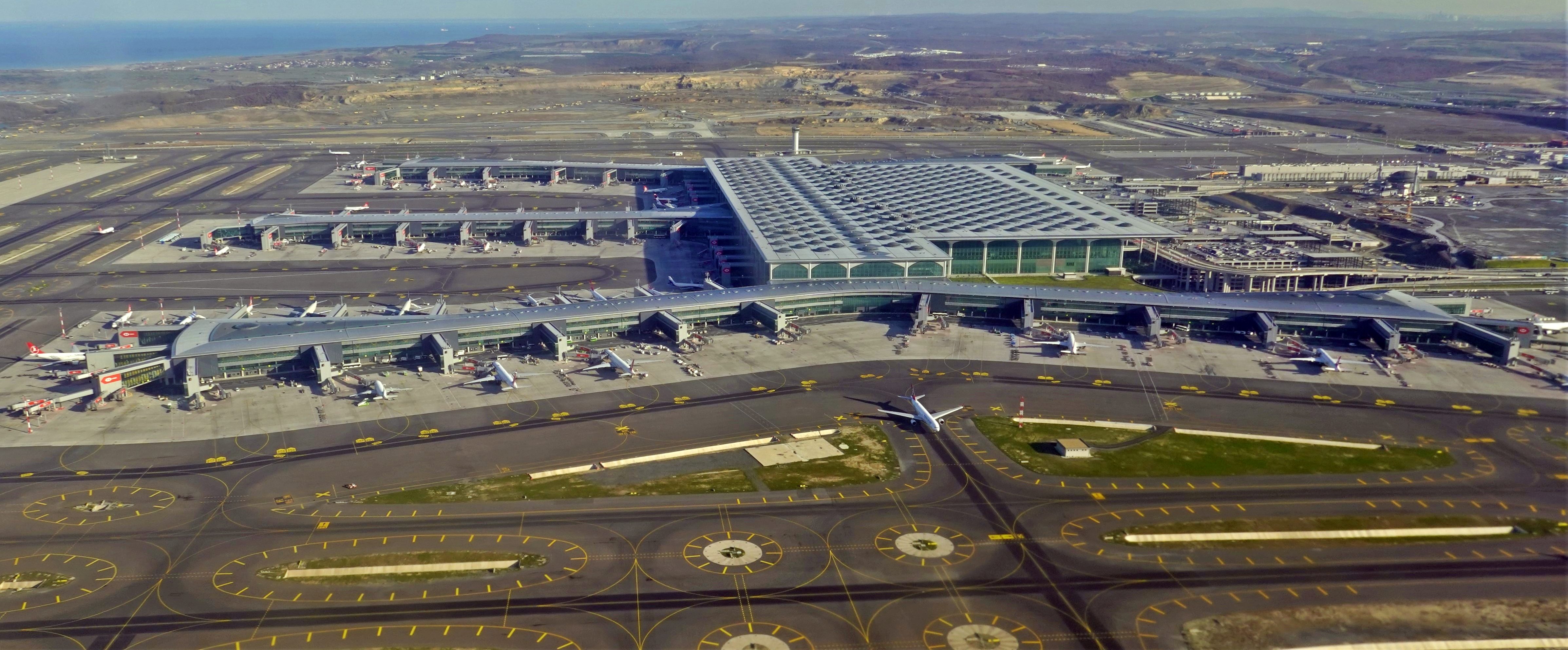
One terminal, no terminal numbers
Unlike Heathrow, CDG or JFK, Istanbul Airport has one main passenger terminal. You never need to work out which terminal your airline uses — everyone checks in under the same roof, and all arriving passengers funnel into the same arrivals hall. International gates run along long piers branching off the central building, with domestic gates in their own section. The piers carry letters on the signage, but lettering and gate ranges have been adjusted during expansion phases — navigate by your gate number on the screens, not a pier letter memorised from an old map.
Among the largest buildings in the world
The terminal is routinely described as one of the largest airport buildings on the planet, handling tens of millions of passengers a year with room to grow. Exact floor-area and capacity figures vary by source and construction phase, so we will not pretend to a precise number — the airport publishes current stats at istairport.com. What matters practically: the walk from one end of the airside area to the other is measured in kilometres, not corridors, and every buffer this site recommends is padded because of this building.
The one rule for navigating IST
The terminal is still being expanded and refitted, so pier letters, door numbers and level names shift with the works. Signage is updated first and is always right. When anything on this page — or any map online — disagrees with a sign in front of you, follow the sign, or check the live maps at istairport.com.
02 · Arrivals level
The arrivals level — from jet bridge to taxi rank
Arriving passengers move through one fixed sequence — the only variables are queue length and walking distance.
-
1
Gate to passport control
From the aircraft, follow the yellow Baggage Claim / Exit signs — depending on the pier, this first walk runs 5–20 minutes on travelators. Then passport control: non-Turkish passports queue at the Other Nationalities counters, with e-gates for eligible passports. Queues swing between 5 and 40 minutes with the wide-body arrival banks.
-
2
Baggage halls and customs
The baggage hall is large — check the screens for your carousel number rather than wandering; free trolleys stand between the carousels. You exit through customs via the green "Nothing to Declare" channel — a one-way door into the public arrivals hall. Once through, you cannot walk back in.
-
3
Arrivals hall — meeting point and services
The public arrivals hall is where name-sign drivers, tour greeters and waiting families stand, along with 24-hour ATMs, exchange counters and SIM desks. If you have arranged a pickup, this is where you meet — our airport pickup guide explains the meeting-point system, and the wider arrivals guide covers the whole landing sequence.
-
4
Exit doors to the taxi rank
Follow the Taxi signs to the exit doors — the official yellow-taxi rank runs along the kerb directly outside the arrivals hall, with a coordinator managing the queue. Door numbers change as works progress, so trust the signs over any remembered door. Expect roughly ₺1,200–1,700 to Taksim and ₺1,400–1,900 to Sultanahmet on the meter including tolls — full route-by-route numbers are in our taxi cost guide.
03 · Departures level
The departures level — check-in islands and security
Departures sits above arrivals. Cars, taxis and drop-offs arrive on the upper roadway; coach and metro passengers ride escalators up from the levels below.
The check-in hall
The departures hall is a single vast space with lettered check-in "islands" — parallel rows of desks, each letter serving a block of airlines. Screens at every entrance list which island your airline is using that day; assignments move, so check the screen rather than assuming last trip's island. Turkish Airlines occupies a large share of the hall, with self-service bag-drop beside the staffed desks. An initial x-ray screening at the terminal entrance doors comes before check-in — a Turkish standard that catches first-timers, so add a few minutes for it.
Security and into the airside area
After check-in, passport control and centralised security feed everyone into the same huge airside area of shops, food courts and lounges, with the gate piers branching off it. Security queues vary sharply with the morning and evening departure banks. The full timeline — how early to arrive, fast-track options, what the airside area holds — is in our departures guide.
04 · Levels below
The levels below — metro, coaches and car parks
Everything that is not an aircraft lives underneath the passenger levels. Two below-ground floors matter to travellers.
M11 metro — the deepest level
The M11 metro station to Gayrettepe (~30 min, ~₺42 with İstanbulkart) sits at the deepest public level of the complex — a genuine descent of several long escalator rides from the arrivals hall. Allow about 10 minutes from the hall to the platform with luggage. Follow the M11 / Metro pictogram signs the whole way; the route is step-free with lifts available. Full line details are in our M11 metro guide.
Havaist coach level and car parks
The Havaist intercity coaches (₺170–420 by line — HVIST-1 is the Taksim direct) load at bays on a ground-transport level one floor below arrivals, alongside city buses and the car-park lifts. Level names and numbers have been reshuffled during terminal works, so do not navigate by a remembered floor — follow the Bus / Havaist pictograms down from the arrivals hall. Our Havaist guide covers lines, fares and frequencies.
Multi-storey car parks also connect at these lower levels — if someone collects you by private car, the short-stay car park lifts reach the arrivals hall directly.
05 · Walk times, honestly
Walking times to the gates — the honest version
Official marketing understandably talks up the travelators. Here is what travellers actually report, and how to buffer for it.
What travellers report
From the central security area, near gates take 5–10 minutes and the farthest pier-end gates take 15–25 minutes of continuous walking — figures travellers report again and again, not a worst-case scare number. Long stretches of travelators do most of the work and the route is flat and step-free, but there is no shuttle train: at IST, distance is covered on foot. Add more time with small children, heavy cabin bags, or a duty-free stop.
How to buffer sensibly
Departing: check your gate as soon as you are through security; if it sits at a pier end, start walking 30–40 minutes before boarding time — boarding at IST often opens 45–60 minutes before long-haul departures precisely because of the walks. Connecting: treat an advertised minimum connection as a sprint; 90 minutes or more is comfortable. Arriving: gate-to-kerb typically runs 30–45 minutes including passport control and baggage — useful when telling a driver or hotel when you will emerge.
Gate changes happen — re-check the screens
A gate change at IST can mean a 20-minute repositioning walk, not a shrug. Glance at a departure screen every time you pass one, and keep notifications on in your airline's app.
06 · Services inside
Wi-Fi, water, pharmacies, luggage storage, sleep
The terminal is a small city. These are the five services travellers actually ask about, with the honest caveats.
Free Wi-Fi with a foreign SIM
The standard free Wi-Fi portal sends a login code by SMS — useless if your foreign SIM has no roaming. The workaround IST provides is self-service kiosks that issue a free access code, typically after scanning your passport or boarding pass. The mechanism has changed over the years and may change again, so follow the Wi-Fi signage or ask an information desk. The bulletproof alternative: install an eSIM before you fly and skip the portal entirely.
Water and everyday needs
Water fountains exist airside — bring an empty bottle through security and refill rather than paying airside prices. ATMs and 24-hour exchange counters sit in the arrivals hall; convenience kiosks are scattered landside and airside.
Pharmacies
There are pharmacies both landside and airside, typically open long hours, stocking painkillers, travel-sickness tablets, baby essentials and basic first aid. Exact locations move as retail zones are reworked — follow the green pharmacy cross or ask at an information desk. Prices run higher than city pharmacies, so buy only what bridges you to town.
Luggage storage and sleeping
A staffed left-luggage service operates landside around the clock, charging per item per day by bag size — locations and prices in our luggage storage guide. For long layovers and overnight stays, the terminal has paid lounges, nap capsules, an in-terminal hotel and workable free-sleep corners — mapped honestly in our sleeping at Istanbul Airport guide.
07 · Reduced mobility
Reduced mobility in a very large building
The scale that tires everyone else is a genuine accessibility issue — but the assistance system is real and free.
Airport and airline assistance
IST operates a passenger assistance service — wheelchairs, escorted transfers through the terminal, priority lanes — free of charge when requested through your airline at least 48 hours before flying, the standard international route. Assistance desks and marked meeting points exist for passengers who arrive without a booking, though pre-arranging is far more reliable. Routes are step-free, with lifts paralleling every escalator down to the Havaist and metro levels.
Door-to-door instead of terminal marathons
If the walk from kerb to gate — or gate to kerb — is the problem, the highest-value fix is cutting the ground-transport legs to zero: a driver who meets you inside the hall, takes the luggage and brings the car to the closest permitted point. Vehicle options and meeting arrangements are covered in our accessible transfer guide.
08 · FAQ
Istanbul Airport terminal — frequently asked
The questions travellers actually search about the IST building itself.
How big is Istanbul Airport?
Very big — Istanbul Airport (IST) operates one of the largest single terminal buildings in the world, handling tens of millions of passengers a year under one roof, with international gates spread along piers that branch off the main hall. Exact floor-area figures vary by source and the site is still being expanded, so treat any number you read as approximate. The practical takeaway is simple: distances inside are real, so add walking time to every plan you make.
How long does it take to walk to the gates?
Travellers consistently report 15–25 minutes of walking from the central security area to the farthest gates, and 5–10 minutes to the nearest ones. Travelators cover much of the distance and the route is step-free, but the piers are long. Check your gate on the screens as soon as you are airside, and start moving 30–40 minutes before boarding time if your gate is at the far end of a pier.
How do I get free Wi-Fi as a foreigner?
Foreign phones usually cannot receive the SMS code the standard portal sends, so IST provides self-service kiosks that issue a free Wi-Fi access code — typically by scanning your passport or boarding pass. The exact mechanism has changed over the years and may change again, so follow the Wi-Fi signage in the terminal or ask at an information desk. If the kiosks are busy or moved, an eSIM bought before you fly is the reliable fallback.
Where is the taxi rank at Istanbul Airport?
Outside the arrivals hall, on the kerb directly in front of the exit doors at arrivals level. Walk out of baggage claim through customs into the public arrivals hall, then follow the yellow Taxi signs to the doors — the official rank with its coordinator is immediately outside. Exact door numbers shift with terminal works, so trust the signs rather than a remembered door number. Our pickup guide covers meeting a pre-booked driver step by step.
Is there luggage storage at Istanbul Airport?
Yes. A staffed left-luggage / baggage storage service operates landside around the clock, charging per item per day with prices tiered by bag size. Its exact counter location has moved during terminal works, so follow the Baggage Storage or Emanet signs or ask at an information desk. See our dedicated luggage storage guide for current prices and practical tips.
Are there pharmacies landside and airside?
Yes — Istanbul Airport has pharmacies both landside (before security, useful on arrival) and airside (after security, useful before a flight), typically open long hours. Locations shift as retail areas are reworked, so ask at an information desk or follow the green pharmacy cross signs. Basic painkillers, travel-sickness tablets and baby essentials are all stocked; prices are higher than city pharmacies.
Which level do I go to for the metro and Havaist?
Both are below the arrivals hall. The M11 metro station is the deepest public level of the complex — several escalator rides down, allow ~10 minutes from the arrivals hall to the platform. The Havaist intercity coach bays sit on a ground-transport level below arrivals, one level down. Level names and numbering on signs have changed during terminal works, so follow the Metro (M11) and Bus / Havaist pictogram signs rather than a remembered floor number.